Showing posts with label National Trust. Show all posts

Tuesday, July 20, 2010

Belton Revisited


Our first visit to Belton house was almost a year ago and where I suffered from an acute case of photo deprivation when my then Canon camera had a touch of the wobblies.

Things have moved on since then, and over the last 12 months or so I have grown to be quite fond of the new Finepix camera which if I am honest I use much of the time in auto mode. Lazy if you like, but the results are not generally too bad, and there are plenty of manual options if the conditions demand it. The “I feel lucky” button on Picasa seems to hide a multitude of sins for most shots from the camera and I admit to having used it occasionally.

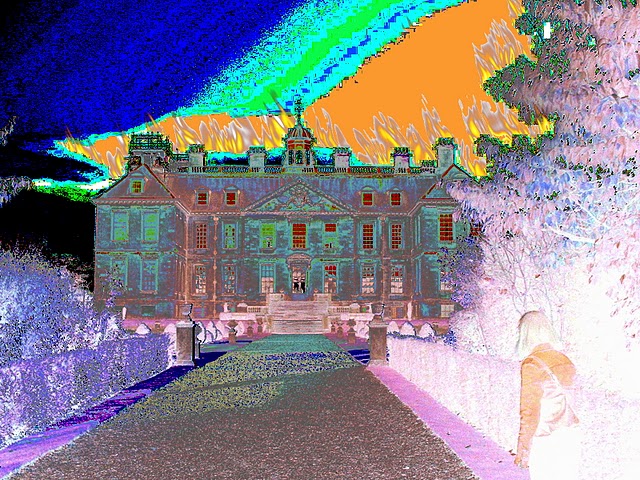
This picture of Belton House wasn’t with the new kit, nor did it come out of the camera looking that way. This is art! Picasso might have been proud of it, but, then again, maybe not. Andy Warhol perhaps? More likely someone not in full possession of all their faculties. That would be me then.

I did promise myself after the last trip to Belton that we would go again and try to recapture some of the pictures that got away the last time. So with the weather in the gorgeous setting, off we went, and 58 miles and only one wrong turn later we duly arrived. Time for lunch, then off to the gardens.


The entry point to the gardens takes you into the sunken Italian Garden which is overlooked by the Orangery completed about 1820 by Jeffry Wyatville and built on the site of the old manor house. These formal gardens were created around the same time and at their best are simply breathtaking. The grass is a bit dried up, but hey, that’s the price for great weather. After the last day or so it may well already be turning green again. As the National Trust are in charge there is no chance of seeing a sprinkler at work, and quite right too. Why does my garden not look like this? Well, the grass is pretty similar, but there the comparison ends, and in any case  I don’t have several acres at my disposal, nor the plant knowledge, nor the funds, nor the time, nor....


Opposite to the Orangery is this lion headed exedra set off by 10 containers of trailing geraniums. Hands up all those who are not familiar with “exedra”. Yes, me too; before my research that is; it is, apparently, in architecture a semi-circular recess often set into a bulding’s facade. This one lacks the facade element, indeed, no building, and also the bench referred to in some definitions upon which conversations could take place is absent. We hadn’t been here long and already a sit down and a chat would have been welcome, but you get used to not having it all on days out in the country.


Around a central pond and fountain is a large circular retaining wall providing a formal edging to the flower borders. Being Italian there had to be stone urns, each with its geranium revelling in the warmth and the sunshine. I was by now very pleased to have made the journey, and even my wife didn’t complain at the number of photographs being taken. Here a click, there a click, everywhere a click, click.


Further around the circle and the display evolves into salvias and dahlias, again flowering their hearts out. Whenever either of these plants have been lovingly put into our garden there has been an immediate slugfest and a display of denuded stalks at best has been the result. At Belton there was no evidence of slug pellets so that I have no idea what their secret is. Maybe they come out in the early hours and shoot them!
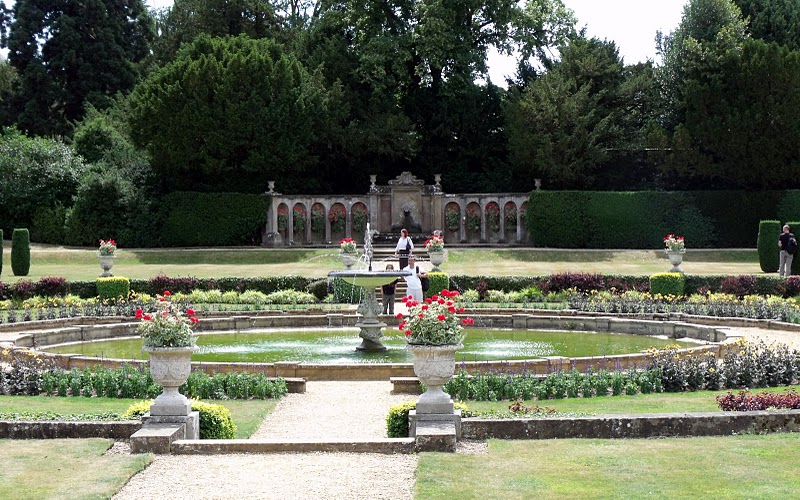


At one time I was not too keen on the formal garden, rather preferring the more natural look such as at parts of Hidcote Manor in Gloucestershire. Maybe it was the near perfect weather with warm sunshine and a cooling breeze, but I couldn’t get enough of this formality. I am not sure how many gardeners are employed, but for me they deserve a medal for such perfection.  As Rudyard Kipling said in THe Glory of the Garden:
Our England is a garden, and such gardens are not made
By singing: -"Oh, how beautiful!" and sitting in the shade.


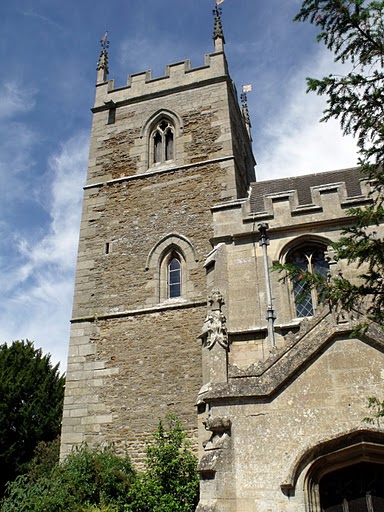
Just to the side of the Orangery is the local parish church of St Peter & St Paul. This is not owned by the Trust, but is well worth a visit to see the wealth of monuments and memorials to the Brownlows and Custs, many of whom are buried there. It was also a welcome bit of shade for a few minutes. Sadly for me churches are little more than a photo opportunity as I cannot confess to having any strong beliefs regarding religious matters, ‘though church music does have a place in my soul even though you wouldn’t want to listen to my unmelodious outpourings in this regard.
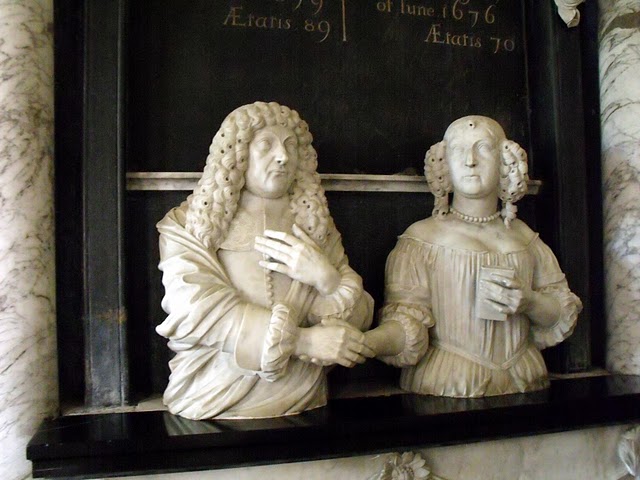


This rather touching monument is to the “Old” Sir Brownlow and his wife Alice. They had no children of their own, but brought up his great-niece Alice Sherard and had close links to his great-nephew ‘Young’ Sir John (grandson of his brother Sir William); the two young people had both lost their fathers in 1668. To ‘Old’ Sir John’s delight, they were attracted to one another and married in 1676. Don’t you just love a happy ending.
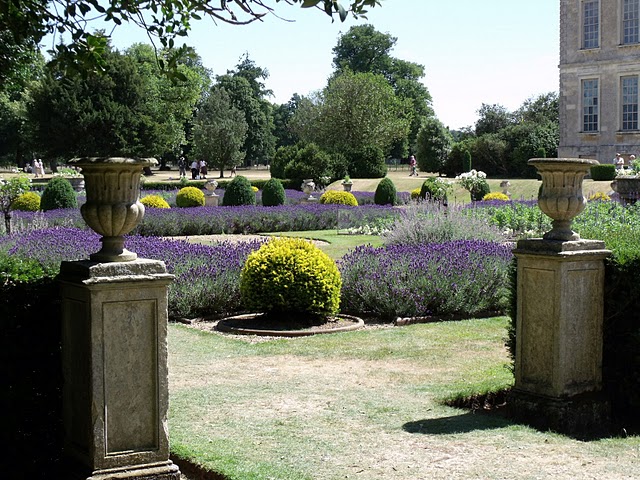


Leaving behind the cool of the church we hopped across Europe to the Dutch garden. Unfortunately I cannot adequately convey the perfume in the air from the masses of lavender all in full bloom. Again it is all formality but as explained before, I’m hooked. A London Lavender Seller’s Cry from around 1900 tackled a problem not actually apparent at Belton:
“Here’s your sweet lavender
sixteen sprigs a penny
that you’ll find my ladies
will smell as sweet as any"
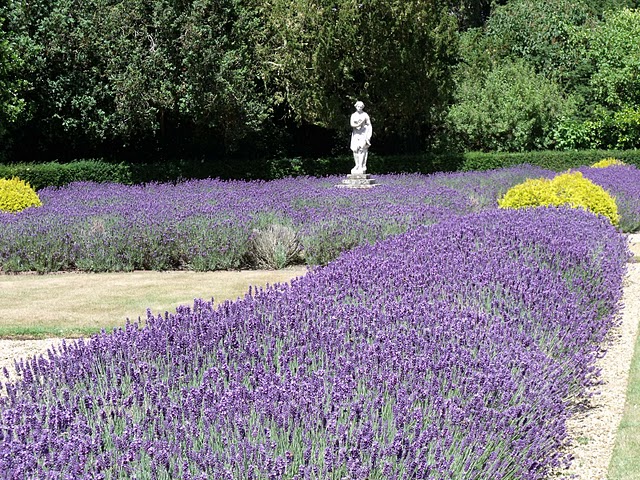


Just how much lavender there is can be seen here in just one corner of the Dutch Garden. The last time I saw more was in Provence many years ago where of course it is grown commercially. That too was memorable, but somehow Belton has even more of a wow factor. And it’s not French!
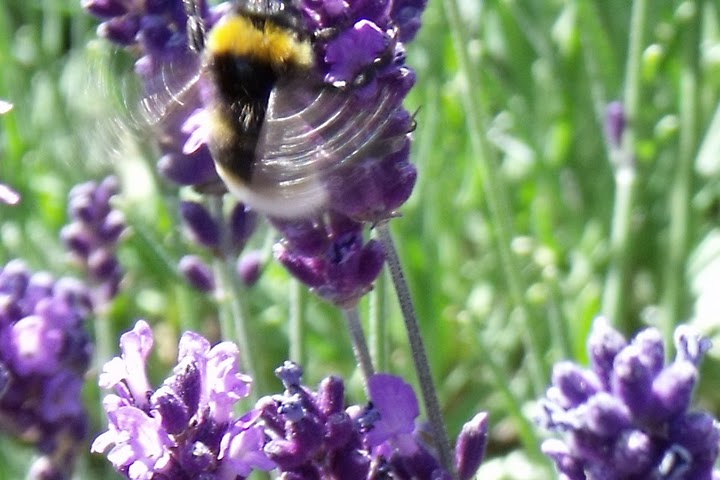


The bees were going absolutely crazy to get at the lavender; there must have been hundreds of them. But would they stay still long enough to get a decent photo? Would they heck! Not only bees were impressed by the feast before them. Even Edward Lear recognised the value in his poem :
“The Pobble who has no toes
Had once as many as we;
When they said "Some day you may lose them all;"
He replied "Fish, fiddle-de-dee!"
And his Aunt Jobiska made him drink
Lavender water tinged with pink,
For she said "The World in general knows
There's nothing so good for a Pobble's toes!"


I say nothing about my toes but we do have some lavender in our garden.
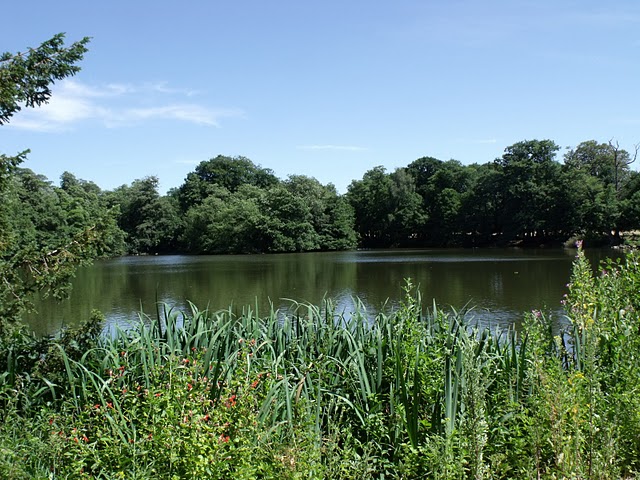


Although by now it was getting very warm we took a walk through the park to the lake which was a scene of peace and tranquillity and the sight of all the water seemed to make it feel cooler. In all probability there was really little difference, but it felt better. The lake is home to an army, or should that be navy, of greylag geese who earlier in the day we saw keeping the grass short in the Italian Garden.


The boathouse was built by Anthony Salvin in 1826 and was one of the earliest examples of his work, in this case an”Alpine Tudor” design. It has been recently restored by the Trust and was attracting quite a lot of attention.
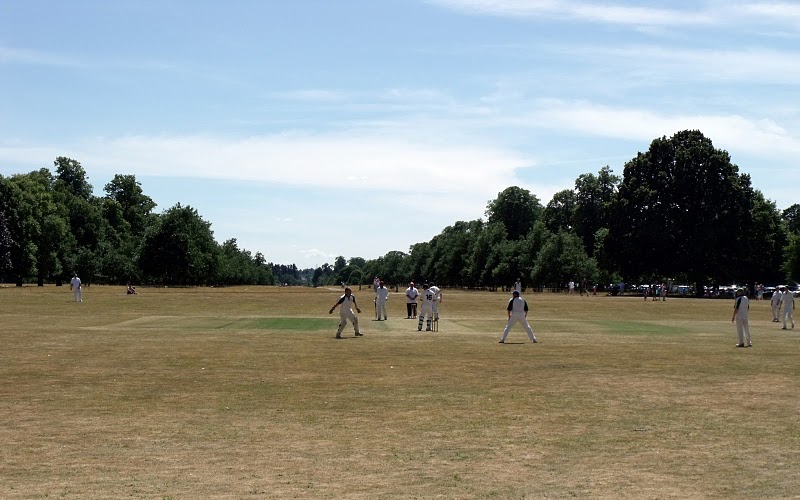


A walk back to the house took us by this quintessential English country house scene. A cricket match on the lawn. Too many sixes could have taken care of some pretty expensive windows , but I don’t think Botham was playing that afternoon. There had been a warning notice advising visitors to beware  the cricket balls; sound advice I’d say. Cricket is something else that has never greatly appealed to me. It just goes on and on and sometimes, five days later a draw is declared. There has to be something wrong if after 5 days you still cannot sort out a winner. And don’t mention the weather!


The front steps led straight onto the cricket pitch, but we reluctantly tore ourselves away from the excitement outside and went within to see how the family lived. Although photography is now allowed in many National Trust houses I did not avail myself of the opportunity on this occasion as the light levels were very low to protect the fabrics and pictures on view. The rooms show a progression of styles from the 17th century to early 20th, the period that the Brownlow and Cust families lived in the building. It was certainly a visit well worth making and I can definitely recommend it as a perfect day out.

Looking at the clouds now massing again outside today it would seem that normal English summer service is being being resumed. I’m very pleased that we went when we did.

Monday, June 28, 2010

Blickling Hall & Gardens, Norfolk

During our break in Norfolk last year we stayed in the Tower on the Blickling Hall estate and obviously we had to go to have a look around the big house. Being National Trust, no photography is allowed inside the house, but the gardens are most enjoyable for a walk around and there are no restrictions on where you point the lens.


The current structure of Blickling Hall was built in the early 17th century and is one of England's great Jacobean houses. It has a spectacular long gallery, superb library and fine collections of furniture, pictures and tapestries.The name Blickling was originally believed to derive from the Old English word 'Bekeling' meaning water-meadow but more recently it is thought to indicate the settlement of the family or followers of one Blicla. Blickling has been the site of a manor house since long before Sir Henry Hobart built the mansion which can be seen today.

The approach to the south front of the house is along a very impressive driveway with the servants quarters to either side. They seem to have been looked after pretty well. On the right hand side they are now use for the NT shop and restaurant. If you want to eat there then I would recommend that you go early if at the weekend or holiday times as it gets very busy and tables are not that plentiful.


The house is a considerable size with most of the formal gardens on the west front. In the middle of September last year the formal borders were still at their best, with enough flowers to satisfy the most hoticulturally deprived person. The house viewed from any side is truly magnificent, but the similarity of the architecture can be a bit confusing when trying to identify the exact location later.


Even plants that had once been spectacular in bloom were not going give up in a hurry and still had much to commend them at this stage in their cycle. These I believe are probably Cardoons, but don't quote me on that.


Still on the west side, the house forms a fine backdrop to the planting. The house is a sumptuous confection of local red brick and Ketton limestone, with Dutch gables and turrets. The present garden was created during the mid-Victorian period but was later remodelled by Norah Lindsay, an influential disciple of Gertrude Jekyll, and these designs have been closely followed by the National Trust.


The borders harbour some lovely surprises like this Salvia Hormonium Clary which is ralated to sage. This one is usually grown as an annual and appears as a faux tropical plant in some collections. The ones we found at Blickling seemed to be in fairly sunny positions, but generally they like some shade and are not fully hardy. I must be careful here or a theme might develop with it becoming  apparent that I watch Gardener's World. Actually my wife is the expert in this area, but I do like to get my hands dirty from time to time.


No National Trust Garden seems to be complete without some dahlias, and Blickling is no exception. Visiting late in the season is always rewarding in this respect and it compensates for the lack of success we usually have in growing our own. The usual pattern is to plant some, watch them develop nicely and then, when your back is turned, the slugs come along and eat them. We have quite a lot of frogs in the pond and even they still leave enough slugs to inflict fatal dahlia damage.


A recent trend in gardens now seems to be growing edible plants among the borders, such as this Red Chard which makes an attractive addition to the flowers. I am not sure what the borders would look like if you picked and ate too many of them. Actually, saying it is a modern trend is probably not the case as I do remember Geoff Hamilton promoting his kitchen garden where such planting was useful in a small garden particularly. But that brings me back to the slugs.


Garden gnomes are nothing new either, although this one would seem to have lost his hat.


Someone seems not to have enjoyed his sprouts!


Across the park there is an Orangery, built in 1782 it is believed, by Samuel Wyatt. Originally it would have contained a good collection of oranges, but as it is now unheated there is a reliance upon hardier plants. This chap seemingly was not too fussed by the chill in the air.


There was indeed at least one plant which I can only assume was an orange, or at least a citrus fruit of some sort.


Orange Blossom?


A central avenue runs through the park, at the end of which stands this impressive Doric Temple, built about 1730. The woods to either side were planted around the same time, but were later re-established during the Victorian era.


Turning and looking in the opposite direction you get a fine view of the house, but get little inkling of the parterre garden hidden in the dip at the centre point of the drive. There has been a park here since medieval times and much of it was owned by the Bishop of Norwich. Humphry Repton was responsible for much of the landscaping during the late 18th century and continued by his son John Adey Repton in the 19th.


Guarding the route along the avenue to the Temple stand tese two impressive stone Sphinx statues.


At each of the four corners of the parterre are some feature flower borders, still looking pretty good  in mid September. The parterre, also known as the Lothiann's Garden was created during the mid-Victorian period but was later remodelled by Norah Lindsay, an influential disciple of Gertrude Jekyll.


To the north and eat of the house lies the lake, established around 1729 to form one of the main features at the time. It is now a very peaceful place to wander and admire the water birds, although on this occasion they mostly seemed to be congregating on the far side.


This picture is one I took at Blickling, but back in 2004 on probably our first visit there. I like trees and often find that some of the best angles are from close to and looking up at them. The bit of cloud seemed to be in just about the right place too.

Monday, August 28, 2006

Glendurgan Garden, Cornwall

Situated next to the Trebah Estate are the, probably, even better gardens of Glendurgan. Created in much the same style of typical Cornish valley garden by the same Fox family, it takes full advantage of the mild climate to grow nearly sub tropical plants. It has been looked after by the National Trust since 1962 although the house is still owned by the family.

The famous Glendurgan Maze

Click here to view more pictures from the visit

Wednesday, August 16, 2006

Levant Mine, Cornwall

Since retiring we have spent quite a lot of our new free time wandering around some of the many stately homes and gardens that are to be found all around the country. I have not been a great one for mechanical things, and have generally preferred to ignore steam fairs, motor shows and the like, never really being able to get excited by gleaming metal, piston rods and spurts of smoke and steam.

Back in the Spring whilst holidaying in Cornwall we decided that we would have a look at some of our industrial heritage and so set off to visit Levant Mine near to St. Just, perhaps one of the most famous of the many tin mines. Although renowned for tin production, actually most of the production was copper, tin appearing towards the end of its life. Although many of the buildings are now in ruins, careful restoration by the National Trust of some of them helps to give a clear indication of how impressive the mine was in its prime. And the scenery along the coast is stunning.

We joined a guided tour and I have to admit that I found the guide's enthusiasm for his subject quite infectious and did actually enjoy the moment when we went into the engine house to see the restored beam engine come to life. What was really interesting was the constant stream of facts relating to the lives of the miners in bygone days which really bring home the need for some of the Health and Safety matters that we sometimes find so irksome in our lives today. The excellent Levant Mine web site gives much more information.


Click here for more views from the visit.

Thursday, August 03, 2006

St Michael's Mount, Cornwall

Situated at the South-eastern tip of Cornwall is probably one of the most evocative of all the properties owned by the National Trust. It is an island at all but low tide conditions, and access is by a short boat ride, and whilst it is possible to walk over the causeway when the tide is out, it feels more like you have taken a journey if you use the boats.
One requirement of a visit is that you are reasonably fit as the climb up to the castle is steep and can be slippery in wet weather. A wonderful garden has been created by the St. Auben family on the slopes all around the castle. The effort required just to walk around them makes you realise what it must have taken create them.


For more pictures, click here

Thursday, July 27, 2006

Hardwick Hall, Nottinghamshire

We had a very hot but enjoyable day out visiting Hardwick Hall recently. The house, now managed by the National Trust, is one of the finest Elizabethan properties to be seen and reflects the wealth of Bess of Hardwick for whom it was built in the 16th century.

The gardens are largely formal, and there is a restored herb garden which it is well worth making the effort to see.


For more pictures of the visit, click here

Sunday, June 25, 2006

Hidcote Manor Gardens

Situated on the northern edge of the escarpment of the Cotswold Hills in Gloucestershire is a magnificent Arts & Crafts garden, created by Major Lawrence Johnston. The position creates considerable climatic problems that have to be overcome, but you would never know it when you see the results.

The house is not open to the public apart from parts of it used for its tea-room and shop. 
Lawrence Johnston was born in Paris and came to England to study at Cambridge. His mother bought Hidcote Manor in 1907 and he started to develop it soon after.


Each room or compartment is themed, and this photograph in October maintains the colours from earlier in the year.


Here we can see the red border in the autumn.


I just love lilies.

For more pictures of the whole garden gathered over a number of visits, click here.


Tuesday, June 13, 2006

Shugborough Hall

Last weekend, we took a trip to Shugborough Hall in the Trent Valley, Staffordshire. This is another National Trust property, although the estate is wholly financed, administered and maintained by Staffordshire County Council. Our main interest was the house and its gardens, but there is a great deal more to do there in the form of museums, exhibits and working farms, much of which would have appeal for the younger visitor. The house was until recently the home of the late Earl of Lichfield, whose photography was of particular interest to me, and there was a wonderful exhibition of some of his photographs which make me realise I have a long way yet to go!


The original house was built in 1693 but greatly added to during the mid part of the 18th century by the Anson family.


The house sits beside the River Sow some few miles upstream of its joining with the River Trent. It is a very pleasant setting for the house and its gardens, although the formal gardens will require a few weeks yet before the roses are all in bloom, when I am sure they will be magnificent.


Away from the house there are some very fine walks alongside the river which at this time were splendid for their rhododendrons and azaleas. In the grounds are several neo-classical monuments, one of which is "The Shepherd's Monument" which takes its name from the marble relief depicting two lovers listening to an ancient shepherd, and is based on a painting by Nicholas Poussin.
If you look more closely at the base you can see an inscription.
This is said by some to be a "Da Vinci" code as Poussin was thought to be a Grand Master of Knights Templar and the original painting is housed in the Louvre, although the code was actually added by Thomas Anson. The dots after the letters are believed to indicate that these are only the first letters of words and in 2004, Bletchley Park code breakers were invited to try to crack the code. I think they are probably still working on it.


For more information see Shugborough Hall, and for more pictures of my visit see my Shugborough Album .

Sunday, June 04, 2006

Packwood House again

We took a trip to Packwood House again last week, mainly to see what was going on the gardens. We were not dissapointed by the plants, but, it being a Bank Holiday, and not wishing to be too snobby, there were one or two less desirables in attendance. One couple, although obviously not unintelligent, were encouraging there beloved offspring to try to jump across the ornamental pool in the sunken garden without falling in. Unfortunately they didn't (fall in that is), but the otherwise serene atmosphere was greatly disturbed.
Should I, or someone have said something to them? They certainly had plenty of disapproving looks, but to little effect, so I think that they would have been truely amazed that they might be causing offense.
Otherwise the gardens were magnificent as I hope these photos show:


More photos from previous visits to Packwood.